
Ficus burkei
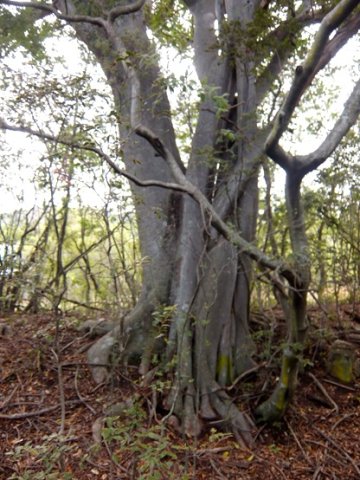
Author: Ivan Lätti
Photographer: Ivan Lätti
Ficus burkei, the common wild fig, is a medium-sized to large tree reaching heights up to 18 m (SA Tree List No. 48). It may grow a dense, leafy crown, sometimes spreading wider than it is tall, but not always, and definitely not where this tall tree was seen near the Magaliesberg. The common wild fig is very variable in its appearance, mostly evergreen, but may sometimes be briefly deciduous.
The name F. thonningii was also used in South Africa in the past for this species, but F. thonningii has become the accepted name for a different species occurring in West Africa.
The leaves are alternate, spiralling or whorled, growing on green, yellowish or reddish petioles, varying much in length, from 0,7 cm to 4,8 cm. Stipules are often present, mostly dropping early, leaving scars. The leaf shape is elliptic, oblong or obovate ending in a rounded or pointed tip, and with tapering or narrowly rounded base. Leaf margins are entire and sometimes wavy. Lateral veins ascend from the midrib, curving in and becoming obscure before they reach the margins; the basal pair inconspicuous. Net-veining is clearer to see on the pale, lower leaf surfaces than the dark-green, faintly glossy upper ones.
The species distribution is widespread in South Africa north of the Vaal River, as well as in KwaZulu-Natal and the Eastern Cape in a broad coastal strip. It is also common in many parts of tropical Africa. It is interesting that the trusted botanical literature ends the southerly distribution range of the species in the Eastern Cape, while many sightings of the tree are now recorded in photos on iNaturalist in the Western Cape, particularly in the Cape Peninsula. Can there be so many park and garden plantings of the popular tree? Or is the species seeding itself in escape mode, capitalising on its multiple wasp species pollination arrangements, extending the region where it grows. Wait for the natural range indications of this tree species in the literature of the twenty second century, if you can!
The habitat is woodland, bushveld and semi-deciduous forest, often on rocky hillsides, in ravines and near termite mounds. The habitat population is deemed of least concern early in the twenty first century.
Birds, bats and antelopes eat the figs (Coates Palgrave, 2002; Schmidt, et al, 2002; Van Wyk and Van Wyk, 1997; Pooley, 1993; iNaturalist; https://redlist.sanbi.org).