

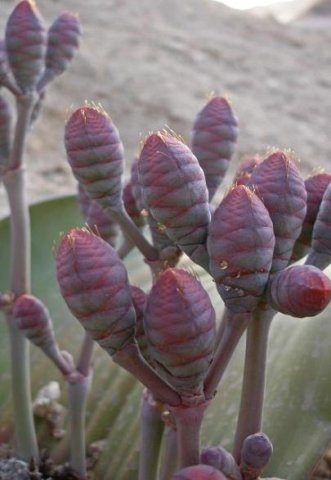
Welwitschia mirabilis female cones purple and grey
Author: Ivan Lätti
Photographer: Judd Kirkel Welwitch
The female cones of Welwitschia mirabilis are covered in overlapping bracts arranged spirally and borne on branched, reproductive shoots. The bracts are thick and fleshy, ridged or keeled, sometimes with resinous or waxy coatings that reduce water loss. The cone pigmentation includes reddish to purplish hues when exposed to sun. This may contribute to protecting the developing ovules from ultra violet radiation.
A cone scale or bract subtends a single ovule, which is exposed, as is the case in all gymnosperms. Cones last for several months as they dry before releasing their seeds. The small, yellowish or greenish protrusions at the bract tips are likely exposed parts of the ovules or associated structures.
After pollination the ovules develop into large, winged seeds equipped for wind dispersal (Mannheimer and Curtis, (Eds.), 2009; iNaturalist; Wikipedia; https://academic.oup.com; https://www.britannica.com; https://www.internetgeography.net).