
Wooleya farinosa bunched stamens
Author: Ivan Lätti
Photographer: Judd Kirkel Welwitch
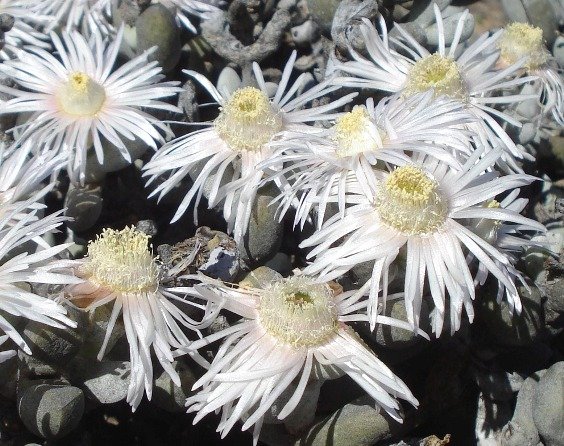
The Wooleya farinosa stamen cones in the flower centres start off floral enough. They are lightly surrounded by staminodes, those incomplete stamens that lack anthers, and only consist of filaments.
The youngest flower in picture has a neat cone topped by a pale-yellow ring of pollen-bearing anthers, and narrowly oblong petals radiating outwards in fairly orderly manner. The oldest flower has a loose scattering of stamens, little remaining of yellow in its anthers, while twisted and bent staminodes are strewn in an uneven circle around them. Most of the petals usually completing the flower picture are already lost from it.
Flowers only have to last until pollinated, then fruiting takes over in the normal run of things. The staminodes act as orderlies in the young flower. They keep the more important stamens, bearing pollen needed for fruiting in position, for the pollinator encounters to come. The inevitable tousled outcome of several insects having their way in the flowers is how things are in the end.
Maybe the initially neat cones would have lasted longer if there had been more staminodes, but then there might have been fewer pollen grains for insects to eat, or carry off to the next flower for pollination. What gives best results is what survives in the evolutionary stakes (Cowling and Pierce, 1999; Smith, et al, 1998; iNaturalist).