
Stones everywhere
Author: Ivan Lätti
Photographer: Johan Pretorius
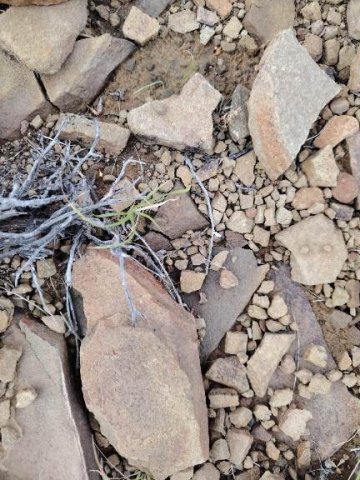
One cannot imagine the Karoo without its particular range of rock and stone. Pieces of sedimentary Karoo rock seen lying around in the veld may include weathered mudstone, siltstone, shale or fine sandstone fragments. Sedimentary rock pieces often appear angular rather than rounded, flattened and slab-like. The pieces mostly break along two-dimensional surfaces rather than showing crystalline fractures. The colours tend towards dull buff, brown, grey and reddish.
Vegetation growth is affected by surface stone, as well as the subsurface geology. Surface stones shade the soil, reduce surface temperatures, reduce wind movement at the soil surface, and retain water longer after rain. This supports plant life better than exposed patches of soil can. The sheltered side of a rock may develop a small fertile island. Nutrient accumulation is aided by the surface stones as dust particles, organic matter and litter become deposited.
Underground, the roots spread into cracks and in the soil, finding moisture and nutrients, some yielded by the rock itself. Minerals released by rocks, accessed by roots, penetrate hair cracks, widening them painstakingly. The yields are numerous kinds of plant foods, including calcium from limestone and dolomite, potassium from feldspar and mica, magnesium from dolomite and other sources, phosphorus in phosphates or apatite minerals, iron and trace elements. Some minerals are obtained from hard rock, others may be more accessible. Moisture and time help.
Mining by plant roots is so much older than any human endeavour in the field. It yields value, whether penetrating Karoo stone shale, mudstone, dolerite, calcrete or something nameless (Norman and Whitfield, 2006; Wikipedia).